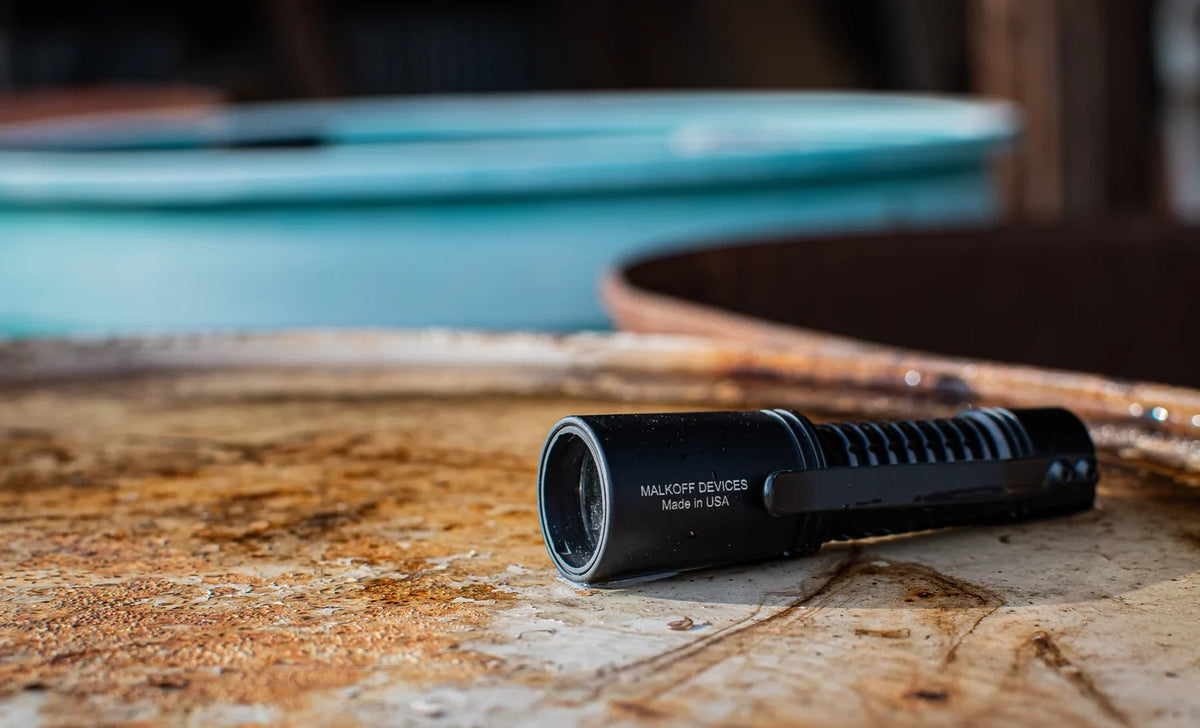
With Malkoff’s current adapter system, converting a compatible incandescent to LED is less of an overhaul than it might sound. You keep the flashlight body and replace the original bulb-and-reflector assembly. The bulb, collet, and reflector come out, and a compatible brass LED drop-in is secured inside a Malkoff Maglite® adapter. No cutting or permanent modification is required.
A Malkoff Maglite® LED retrofit can make a familiar flashlight more useful, but only when the model, cell count, drop-in, and battery setup all line up. This guide walks you through confirming compatibility, choosing a drop-in, sorting out the battery requirements, and installing the conversion.
Already have your Malkoff drop-in and Maglite® adapter? Skip to How to Install a Maglite® LED Drop-In.
Watch: Maglite® LED Conversion with Malkoff Maglite® Adapter
WHY CONVERT YOUR MAGLITE® TO LED INSTEAD OF REPLACING IT?
If the flashlight is still in good working order, it may make more sense to convert your Maglite® to LED than replace it entirely.
When weighing LED vs. incandescent performance, look beyond brightness. An incandescent bulb produces visible light by heating a thin filament, but much of its electrical input becomes heat and infrared radiation. An LED also generates heat, but it converts a greater share of that energy into visible light. Depending on the drop-in and battery setup, that efficiency can support greater output, longer runtime, or a balance of the two.
Converting to LED also eliminates one of the most vulnerable components of an incandescent bulb: the filament. Without a filament to break, the light source is more resistant to shock and vibration. That matters when a flashlight regularly rides in a vehicle, toolbox, duty bag, or emergency kit.
Before upgrading, check the flashlight’s overall condition. Severe battery corrosion, damaged contacts, or worn threads may make replacement more practical. If the flashlight remains mechanically sound, a well-matched LED lighting upgrade can keep it in service for the work ahead.
WHICH MAGLITE® MODELS CAN YOU CONVERT TO LED?
If you want to convert an old incandescent Maglite® to LED with Malkoff’s adapter, start by confirming that your flashlight is a compatible incandescent C- or D-cell model with a user-removable bulb.
These same requirements apply whether you are planning a D-cell conversion or a Maglite® C-cell LED upgrade:
- It uses C or D cells. The adapter does not fit AA or AAA Mini Maglites.
- It is an incandescent model with a user-removable bulb. The adapter does not work with factory-LED Maglites that lack a user-removable bulb.
- Its serial number begins with C or D. The serial number appears on the flashlight body opposite the switch. Malkoff’s adapter does not fit versions whose serial numbers lack one of these letters at the beginning.
- It is not an ML25. Malkoff specifically excludes this model from the adapter’s compatibility range.
Finally, count the cells in your Maglite®. Cell count does not affect whether the adapter physically fits, but you will need it to choose a compatible drop-in.
Once you have confirmed compatibility and noted the cell count, explore the available Maglite® accessories and conversion options from Malkoff.
HOW TO CHOOSE THE RIGHT LED DROP-IN FOR YOUR MAGLITE®
Cell count comes first because it determines the nominal voltage available from standard alkaline batteries. Match that voltage to the drop-in’s rated range before comparing output, beam pattern, or light color. Several drop-ins may fit the same Malkoff Maglite® adapter, but that does not mean they can all handle the same voltage.
For this adapter system, the available drop-in options break down by cell count and voltage:
| Maglite® setup | Nominal voltage | Drop-in options | Approximate output |
| 2-cell | 3 volts | M31 or M31W | 300–350 lumens |
| 3- to 6-cell | 4.5–9 volts | M61, M61N, or M61W | 400–500 lumens |
| Higher-output 4- to 6-cell | 6–9 volts | M61HOT V2 or M91 series | 800–1,000 lumens |
These figures apply to the battery arrangements specified by Malkoff. If you plan to use anything other than the listed alkaline setup, check the drop-in’s voltage requirements first. A battery can fit inside the flashlight and still supply the wrong voltage.
BALANCE OUTPUT WITH RUNTIME
The brightest Maglite® upgrade may look like the obvious choice, but more output comes with greater power demands. A high-output module can be useful when you need to light up a larger area or see farther downrange. For general navigation, close work, or longer periods of use, a lower-output option may give you a better balance.
The reflector or optic determines where that light goes. Most of Malkoff’s listed Maglite® options use an orange-peel reflector that balances the central hotspot with surrounding spill. The M61HOT V2 and M91T use tighter optics that concentrate more light in the hotspot for greater throw.
PICK A USEFUL LIGHT COLOR
Cooler white options provide the highest listed output in several of the available families. Selected neutral- and warm-white M31 and M61 models trade some of that output for high color rendering, which can make colored details appear more natural.
The better choice depends on whether maximum output or easier color identification matters more for the job.
CHECK WHAT IS INCLUDED
Unlike a one-piece Maglite® replacement bulb, Malkoff’s current conversion requires two parts: a compatible brass LED drop-in and the Maglite® LED Adapter Universal D&C Size.
Malkoff offers the adapter by itself or paired with several drop-ins. Check the selected product option before ordering so you know whether your cart contains only the adapter or both parts required for the conversion.
WHICH BATTERIES SHOULD YOU USE AFTER THE CONVERSION?
For the standard conversion, use the original number of alkaline C or D cells specified for your Maglite® and drop-in combination. An 18650 Li-ion setup requires a separate Malkoff battery adapter and is limited to compatible D-cell Maglites and drop-ins.
USING C OR D ALKALINE BATTERIES
Malkoff bases its runtime estimates for these Maglite® conversions on alkaline batteries. Each alkaline cell supplies about 1.5 volts nominally, so adding cells increases the total voltage. The M31 and M31W are rated for no more than 3.2 volts and will be damaged in three- to six-cell alkaline setups.
Maglite® LED battery life depends largely on battery capacity and the drop-in’s current draw. Higher-output modules generally draw more current. D cells also generally have greater capacity than C cells of the same chemistry, which is why the published tables estimate approximately half as much runtime for comparable C-cell setups.
Those estimates can vary with battery brand, age, condition, temperature, and usage patterns.
TREATING LI-ION AS A SEPARATE CONVERSION
An 18650 is not simply a smaller substitute for a C or D cell. Two alkaline cells provide about 3 volts nominally, while two Li-ion cells provide about 7.4 volts nominally and can reach 8.4 volts when fully charged. That is enough to damage a drop-in that is not rated for the higher voltage.
Malkoff’s 2D Li-ion battery adapter holds two protected, button-top 18650 cells and is designed for compatible incandescent 2D Maglites using the specified M61HOT V2 and M91-series drop-ins. It is not compatible with an M31 drop-in or a stock LED Maglite®.
The separate 3D Li-ion adapter uses a spacer. It can also be installed in compatible 4D, 5D, and 6D bodies with the required number of dummy D cells.
With Li-ion batteries, every part of the setup needs to be compatible. Stick with the protected cells Malkoff specifies and use a charger made for those cells.
HOW TO INSTALL A MAGLITE® LED DROP-IN
Installing a Malkoff drop-in is a straightforward, reversible upgrade that requires no cutting or soldering. Here’s how to do it:
- Remove the batteries and head. Switch off the Maglite®, take out the batteries, and unscrew the head from the flashlight body to expose the incandescent bulb.
- Remove the bulb and collet. Your Maglite® may have a PR bulb or a bi-pin xenon bulb. The PR bulb pops free; the bi-pin bulb needs to be pried out, but it’s a simple operation. Remove the collet that held the bulb in place and leave it off.
- Assemble the LED drop-in and adapter. Unscrew the two halves of the Malkoff adapter, place the LED drop-in inside, and screw the halves back together.
- Take apart the head. Unscrew the bezel and remove the original reflector.
- Install the adapter. Place the assembled adapter and drop-in inside the head, then screw the bezel back on.
- Reattach the head. Screw it back onto the flashlight body.
- Test the light. Reinstall the batteries in the correct orientation, using the setup specified for your drop-in, and switch it on.
If the light does not turn on, remove the batteries before checking their orientation, the flashlight contacts, and how the adapter and drop-in are seated. Use only a battery setup Malkoff specifies for your drop-in; a different configuration could exceed its voltage rating.
WHY CHOOSE MALKOFF DEVICES FOR YOUR MAGLITE® LED CONVERSION
A dependable Maglite® upgrade starts with parts designed to work together. Instead of offering a generic replacement bulb, Malkoff builds its conversion system for select incandescent C- and D-cell Maglites.
That focus on compatibility carries through to the hardware. The system pairs a CNC-machined aluminum adapter with compatible brass-bodied drop-ins built for rough service. To help you compare those options, Malkoff provides approximate output, current draw, candela, beam distance, and alkaline runtime specifications.
Malkoff also warrants its products against manufacturing defects for the lifetime of the original purchaser, subject to its current warranty terms.
Ready to convert your Maglite® to LED but still unsure which combination will work? You can contact Malkoff directly with questions about fit, drop-in compatibility, or battery requirements before or after ordering.
FREQUENTLY ASKED QUESTIONS ABOUT MAGLITE® LED CONVERSIONS
HOW LONG DO BATTERIES LAST AFTER CONVERTING A MAGLITE® TO LED?
A compatible LED drop-in can provide considerably more usable light than the original incandescent bulb while still delivering several hours of runtime. The exact battery life depends on the drop-in, cell count, battery size, and battery chemistry.
For an M61 running on alkaline batteries, Malkoff lists more than four hours in a 3D Maglite®, with approximately two additional hours for each added D cell. Comparable C-cell setups provide approximately half the runtime.
See the complete output and runtime estimates on the Maglite® LED Adapter Universal D&C Size product page.
CAN I USE RECHARGEABLE BATTERIES IN MY CONVERTED MAGLITE®?
Yes, provided the battery setup is compatible with your Maglite® and Malkoff drop-in. Malkoff offers separate 2D and 3D adapters that use two protected, button-top 18650 lithium-ion batteries. The 2D Li-ion adapter is recommended for the M61HOT V2, M91, and M91T drop-ins only. Never use the Li-ion adapter in any stock Maglite® flashlight. The 3D adapter, which fits a 3D Maglite®, can also be used in 4D–6D Maglites with the required dummy cells and a compatible drop-in.
Rechargeable NiMH C or D cells are another possibility when the cell count and battery setup meet your drop-in’s requirements. Do not use a two-18650 setup with an M31 or M31W; those drop-ins must not exceed 3.2 volts. If you’re unsure which setup suits your light, contact the Malkoff team.
HOW DOES USING NIMH INSTEAD OF ALKALINE IN A MALKOFF LED MAGLITE® CONVERSION AFFECT OUTPUT?
NiMH cells are rated at 1.2 volts nominal each, compared with 1.5 volts for alkaline cells. In a four-cell Maglite®, that adds up to 4.8 volts with NiMH or 6 volts with alkaline batteries.
That difference matters for high-output drop-ins such as the M61HOT V2, M91, and M91T. Malkoff lists their output at 6–9 volts, so four NiMH cells may produce less light than the listed output. Runtime may differ too, since Malkoff’s Maglite® estimates are based on alkaline batteries.
DOES THE MAGLITE’S BEAM FOCUS STILL WORK AFTER INSTALLING AN LED DROP-IN?
The original flood-to-spot adjustment does not carry over. That adjustment relies on the Maglite® reflector, which is removed during installation. Each Malkoff drop-in uses its own reflector or optic, so the module you choose determines whether the beam favors throw, spill, or a balance of both.
Compare the options in How to Choose the Right LED Drop-In for Your Maglite®.
Trademark Notice:
Mag Instrument, Inc., which manufactures and sells Maglite® flashlights, is not associated in any way, form, or fashion with Malkoff Devices, Inc. Mag Instrument, Inc. does not manufacture, sponsor, warrant, or endorse any Malkoff Devices, Inc. product advertised on this website. The Maglite® trademark, a registered trademark of Mag Instrument, Inc., is used strictly to identify the host flashlight for the Malkoff Devices, Inc. products advertised on this website. All other trademarks, copyrights, graphics, or text appearing on this site that are not owned by Malkoff Devices, Inc. or any of its related companies are the property of their respective owners, who may or may not be affiliated with, connected to, or sponsored by Malkoff Devices, Inc.